Come Hell or High Water: Co-Conspiratorship During Hurricane Helene

In September of last year, Hurricane Helene brought on catastrophic levels of rain and flooding that ravaged western North Carolina (WNC), Tennessee, Virginia, Georgia, and Florida. No one could have prepared for the unprecedented impact on southern Appalachia, a region where people are raised to remember that the mountains are our protectors.
When the mountains couldn’t protect us, community stepped up. Before the floodwaters receded, people across the state were mobilizing relief efforts. From search and rescue attempts, donation convoys, mutual aid drives, resource lists and more, people swiftly banded together to meet each other’s needs and bring hope back to the hills.
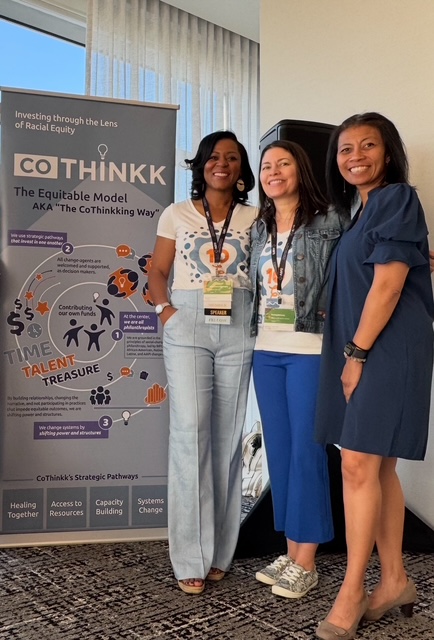
Funder organizers played a crucial role in efforts to rebuild and recover. CoThinkk is a giving circle invested in the economic and social well-being of communities of color in western North Carolina. Their work uses strategic investments for systems change, equity, healing, and civic discourse. We spoke to CoThinkk’s Founder, Tracey Greene-Washington, to learn more about philanthropic solidarity with community, her experience of working with partners for disaster response, and lessons funders can learn for their recovery responses going forward.
“We had to look at the resources CoThinkk had available, what we already did well to support the community, and how we could adapt and evolve for the moment. We listened to community and our partners first, then mobilized and deployed our base-building team, which is comprised of women of color who were directly impacted by the storm. This enabled us to think strategically and innovate ways to deploy resources and make regional grant applications more accessible. Then we brought in leaders from the field and created multiple pathways to tell a more accurate story and be an advocate, both nationally and regionally, in a moment where we saw people of color being invisibilized as the efforts moved from a relief response to long-term rebuilding” said Greene-Washington.
Relationships as Solutions
CoThinkk knew that deploying resources effectively would only be possible by leaning on the deep relationships they had been building with community over the past ten years. Greene-Washington stated “We were acting as co-conspirators and working in solidarity with community. We had a level of trust because we weren’t new in the region. We were already involved in and helping to seed powerful networks, and were wielding and sharing power together. This muscle anchors the very essence of our work as a social change philanthropy.”
While members of CoThinkk’s multiracial, multigenerational, and primarily women-led giving circle were reaching out to their neighbors to understand what people needed, they were also connecting with other funder organizers with expertise around disaster relief in the South.
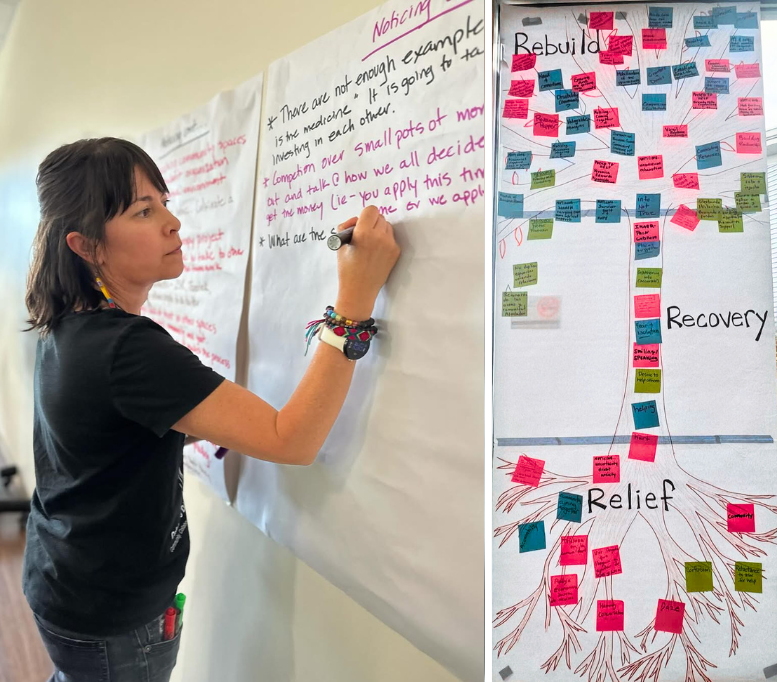
Greene-Washington said “We needed to gather a brain trust that had experience in disaster recovery, particularly in the context of the South, which is home to both urban and rural communities. We partnered with seasoned organizers and grantmakers who helped us plan for what to expect in the first 100 days, while building a framework that would guide our efforts around relief, recovery, and rebuilding. This framework continues to serve as a catalyst and informs our community engagement, strategic investments, and partnerships throughout the region.”
For CoThinkk, co-conspiratorship meant helping community navigate the philanthropic landscape while being in relationship and focusing on deep transformation. They designed a new micro-grant process and committed to disperse 110 grants of $550 quickly, only requiring a W-9 to receive funding. To date, CoThinkk has distributed 65+ of these grants, made possible through initial investments from their membership base and leveraging triage grants from funders, including Mary Reynolds Babcock Foundation, Oak Foundation, Laughing Gull, Funders for LGBTQ Issues’ Out in the South initiative, Borealis via Grantmakers for Southern Progress, and two North Carolina-based sister giving circles, NGAAP and SOAR.
Bringing a Human Touch to the Work
CoThinkk mobilized volunteers to support community members in navigating the grant application process, but they also provided personal care products, space to share emerging trends in the recovery process, and bodywork practitioners to help individuals process trauma through movement. When the local economy was halted, CoThinkk bought care packages curated by people of color-owned small businesses to distribute to the community. They hired language justice organizers they partnered with prior to Hurricane Helene to make language resources accessible for grantee partners and leaders supporting WNC’s Latine, AAPI, and Indigenous populations. CoThinkk partnered with funders and helped them understand emerging challenges in a western North Carolina context, urging them to move in alignment with trust-based practices.
Shifting Landscapes
One challenge was that FEMA statutes have not been adapted to the context and climate of the Appalachian mountains. Ashley Shelton, one of CoThinkk’s brain trust members and President of the Power Coalition, who played a vital role in Hurricane Katrina recovery efforts, advised that most FEMA applicants would likely be turned down initially. This knowledge helped CoThinkk prepare community members for what they might expect during the application process. CoThinkk also saw challenges with grant applications and fiscal sponsorships, where smaller organizations were made ineligible for grants if their fiscal sponsors had already received the same funding. CoThinkk explained how this practice created inequity for smaller organizations doing powerful work but whose infrastructure relied on support from larger organizations.
“We understood that funders were working under pressure. We consistently communicated that we were in this together and shared the same desire – for impacted communities to see positive outcomes and thrive.” Greene-Washington continued “However, we also had to communicate that strategies not grounded in equity would create a ripple effect in every phase of the rebuilding and recovery process. We asked funders the same questions we ask ourselves in any process: What is lost and who is made invisible when we are not centering equity? Who is most harmed?”
Efforts to send gift cards and supply trucks were necessary and well-meaning, but the loss of electricity and lack of internet left people in WNC without ways to communicate to the outside world for weeks, let alone have access to banks, grocery stores, or gas stations. Local vendors only accepted cash initially, and entire roadways were washed out in the floods, making it challenging for people to get in or out. CoThinkk urged funders to think long-term about how the community’s infrastructure needs were compounded by trauma, and to align with people-centered practices. Moving funds to local leaders and organizations situated in community who knew how to get money and resources on the ground quickly was critical.

Collective Giving and the South
CoThinkk’s ongoing advocacy efforts in the wake of Hurricane Helene exemplify what it looks like to practice effective, trust-based, people-centered grantmaking. We asked Tracey Greene-Washington what she wants funders to know about funding in the South.
“When I think about the South, I know that funders investing in giving circles and the giving circle movement is imperative. Giving circles are a strategic partner walking alongside traditional philanthropy and support transformational work to amplify innovative ideas, efforts, and strategies that are often ignored.” She continued. “Collective giving is the balm that supports deep community centered-and-driven solutions focused on systemic change. In this important moment, having alternative vehicles to anchor and mobilize time, talent, treasure, and testimony is critical. I want funders to know that Southern people are passionate and do powerful work, because we are willing to build something bigger than ourselves in service to what we believe in.”
Our key takeaways for how funders can best show up around disaster relief and recovery:
- Recovery takes time, preparation starts now: Building robust support networks, immediate triage, and ongoing, long-term funding are vital. The need doesn’t ease just because the story is no longer a headline. Support must be available before, during, and after disasters.
- Funds need to be flexible: Communities hit by natural disasters, especially in rural areas, need cash in hand to help them survive. Funder institutions must be nimble in areas with limited resources and infrastructure to meet people’s needs.
- Fiscal sponsorships should be an asset, not a barrier: trust-based, people-centered grantmaking asks funders to think creatively about pathways for support so that more people join our movements and get their needs met. Preventing small organizations from receiving funds because their fiscal sponsor has applied for the same grants penalizes them for relying on capacity support and creates unnecessary competition that stifles powerful work.
- FEMA is complex: Community needs support in navigating FEMA requirements to avoid application rejections, and FEMA funds are not enough on their own to achieve real recovery.
- Fund democracy protection and advocacy: Policies that provide additional rebuilding aid, protect property, and prevent land grabs help community thrive. Hurricane Helene hit North Carolina three weeks before early voting began. Our voting landscape is changing, and our civic engagement tools should amplify people’s voices.
- Fund innovative partners, such as giving circles: Giving circles have the ability to pivot quickly to support both immediate and long-term efforts anchored in trust-based practices, equity, and community.
At a time when the philanthropic landscape and our political context is changing rapidly, and as vulnerable communities continue to bear the brunt of inequity, groups like CoThinkk remind us of the power of pooling resources, uniting around a mission, and working collectively to meet the needs of community and provide cover for one another. With the acceleration of climate change, we know more catastrophic storms will come. Preparing now is essential. Building effective movements means prioritizing the most impacted communities, having each other’s backs, and knowing that we are stronger together in the midst of the storm. Lord willin’ and the creek don’t rise.
To learn more from CoThinkk directly, watch their giving circle spotlight and visit their website.
Resources: